Growing Resilience: Why Calgary Needs Community-Led Gardens and Urban Growing Spaces Now More Than Ever
Smriti Arora, Program Director and Co-founder at Roots of Arnica
Food is a fundamental human need that supports physiological survival and is central to daily life; however, its significance extends beyond mere biological sustenance to encompass deeply social dimensions. Access to sufficient, safe, and culturally appropriate food is a fundamental aspect of food security, essential for maintaining health and well-being (World Food Summit, 1996; FAO, 2002). In addition to these material functions, shared eating practices—commonly referred to as commensality—play a critical role in fostering sociality, reinforcing group identities, and strengthening interpersonal and community bonds across diverse cultural contexts (Tuomainen, 2014; Fischler, 2011; Jönsson et al., 2021). Anthropological and nutritional research further demonstrates that food sharing and shared meals are not only ubiquitous across human societies but are also embedded in social norms and cultural models that connect individuals to families and broader social networks (Ulijaszek, 2024). These practices illustrate how food operates simultaneously as a biological necessity and a social medium through which people construct meaning, negotiate relationships, and sustain collective life.
Why Food Sovereignty?
As defined by the United Nations, Food Security is “when all people, at all times, have physical, social, and economic access to sufficient, safe, and nutritious food that meets their dietary needs and food preferences for an active and healthy life.”
The term Food Sovereignty goes a step ahead and “refers to food security that is independently controlled and decided by communities at a local level” (Legare, 2025).
Why Food-Growing Spaces Matter
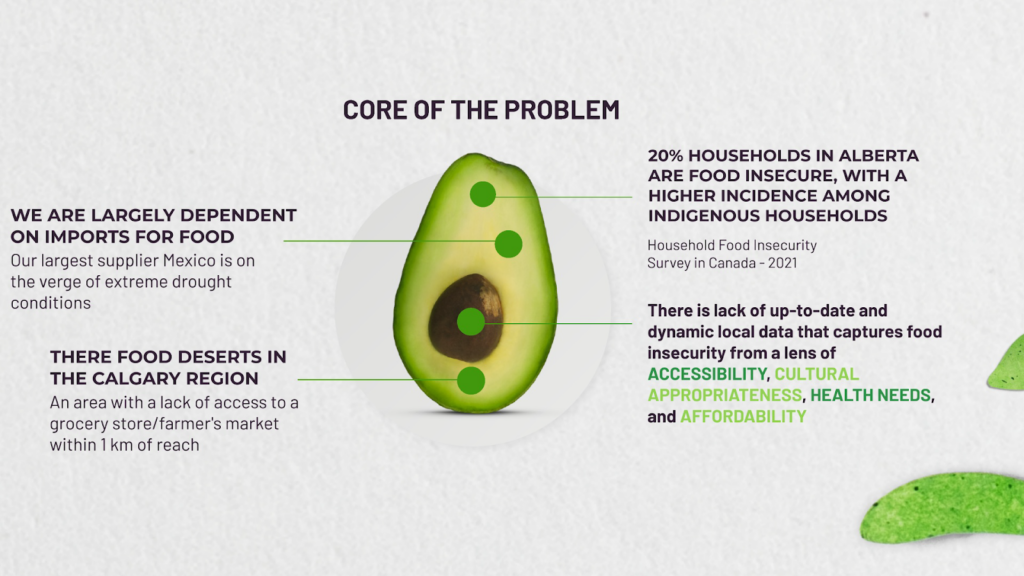
Food insecurity remains a pressing issue across Canada, disproportionately affecting low-income residents, renters, and those facing systemic barriers. A 2023 Statistics Canada study found that families experiencing chronic, year-long unemployment had food insecurity rates three times higher than those who were employed (45%) (Statistics Canada, 2023). Additionally, the report showed that more than half (54%) of families living in subsidised rental housing were food insecure. In comparison, this rate was 41% among non-subsidised renters, 26% for homeowners with a mortgage, and only 14% among mortgage-free homeowners (Statistics Canada, 2023).
These numbers illustrate how deeply income and housing conditions influence a household’s access to food. Despite this, significant data gaps remain—particularly regarding food deserts, the experiences of unhoused community members, and the localised realities of food insecurity in Calgary and its surrounding region. This lack of information highlights the need for innovative, community-driven food production models that emphasise resilience, empowerment, and equity.
Growing Roots, Growing Community
Our initiative responds to these gaps through a comprehensive, community-powered model focused on strengthening food sovereignty and building long-term resilience. Our approach includes:
- Equipping community members with tools, skills, and support to grow their own food confidently and sustainably.
- Co-developing growing spaces in partnership with communities, prioritising areas experiencing the greatest need.
- Establishing Roots of Arnica Community of Care hubs, which will integrate food-growing spaces with access to community resources, a social-impact café/grocery store, and inclusive gathering areas.
- Re-envisioning public and underutilised land through collaborative design and shared stewardship.
- Building partnerships across sectors—including food security organisations, social services, health providers, and agriculture experts—to ensure holistic and integrated support.
- Ensuring long-term sustainability through climate-responsive design, community governance, and capacity-building.
- Collecting aggregated, anonymised data to assess impact, support advocacy efforts, and contribute to filling the city’s existing data gaps and designing projects to fill these gaps.
Building a Resilient Food Future, Together
According to the May 2024 Food Resiliency Survey conducted by the City of Calgary, community members expressed a clear desire for the City to prioritise and expand community gardens and urban farms (City of Calgary, 2024). The findings demonstrate growing public demand for localised food production, improved access to fresh produce, and stronger community food systems.
Calgarians are asking for innovative food solutions, and national research confirms the urgency. By expanding community gardens, urban growing spaces, and integrated support hubs, we can reduce food insecurity, empower households, strengthen community capacity, and build a more sustainable and equitable local food future.
Real resilience begins when communities plant, grow, and thrive together.
References
Food and Agriculture Organization of the United Nations. (2002). The state of food insecurity in the world 2002. FAO.
World Food Summit. (1996). Rome Declaration on World Food Security and World Food Summit Plan of Action. Food and Agriculture Organization of the United Nations.
Fischler, C. (2011). Commensality, society and culture. Social Science Information, 50(3–4), 528–548.
Jönsson, H., et al. (2021). Commensality and social ties in eating practices: A review of recent research. In Frontiers in Sustainability (see article for full publication details).
Tuomainen, H. (2014). Eating alone or together? Anthropology of Food. https://doi.org/10.4000/aof.7718
Ulijaszek, S. (2024). Nutritional anthropology in the world. Journal of Physiological Anthropology, 43(10). https://doi.org/10.1186/s40101-023-00345-0
Legare, M. (2025). Indigenous land sovereignty and food security in Saskatchewan, Canada. In R. Datta, J. Chapola, & J. Acharibasam (Eds.), Indigenous land-based knowledge and sustainability (pp. 51–60). Routledge.
City of Calgary. (2024). Food Resiliency Survey: May 2024 results. https://engage.calgary.ca/food
Statistics Canada. (2023). Food insecurity among Canadian families. https://www150.statcan.gc.ca/n1/pub/75-006-x/2023001/article/00013-eng.htm
